Transforming the largest structural market failure of the 21st century into a $1+ trillion opportunity - through integrated food security infrastructure designed to last generations.

"If you are late in one thing - you are late in everything."
Marcus Porcius Cato. De agri cultura.
Michael Kremer, 1993
In 1993, future Nobel laureate Michael Kremer first presented his O-Ring theory. The name comes from the small O-ring component whose failure caused the Space Shuttle Challenger to explode during launch in 1986 - a reminder that a malfunction in even the smallest part can be catastrophic and fatal.

The Core Insight
Kremer's work goes far beyond a single dramatic fact. It establishes a mathematical framework for understanding why complex systems succeed or fail - and why quality, not quantity, is the decisive variable at every stage of production. The theory applies to everything from manufacturing and surgery to agriculture and food systems. Its implications are profound - and they form the intellectual foundation of the BioSingularity vision.
O-Ring Postulates
The Mathematics of Failure
.01
Multi-Stage Production
Creating any complex product requires the execution of a series of interrelated tasks, and each of them is absolutely necessary for the final result.
.02
Multiplication Effect
The quality of workers' skills at different stages is not added together - it is multiplied. Outstanding talent at one stage cannot mathematically compensate for low qualifications at the next.
.03
Critical Cost of Failure
A defect at even the most minor stage can completely destroy the economic value of the entire finished product. The best chef, finest ingredients, and perfect preparation are all worthless if the waiter drops the dish on the floor.
.04
Quantity Cannot Replace Quality
Eight bad surgeons are a poor substitute for one good surgeon. In fact, eight bad surgeons are worse than one - because their efforts multiply, not add.

.05
Positive Assortative Matching
Understanding the critical cost of failure, people naturally behave in ways that create positive assortative matching. In the labour market, highly skilled specialists cooperate only with professionals of similar calibre - to minimise the risk of their work being devalued.
Workers with low skills are forced to group together. As a result, the influence of the environment on income is far greater than it appears. A person's marginal productivity depends not only on their personal skills, but on the qualifications of every colleague around them.
In a strong team, an employee's skills yield greater returns. In a weak team, even exceptional talent is mathematically suppressed.
.06
If production involves 10 stages and the quality level at each stage is 0.9, the overall quality level:
P = 0.9^{10} = 0.35
A mere 35% overall quality level - despite 90% reliability at every individual step. And if any single stage reaches zero:
0.9 x 0.9 x... x 0 = 0
Three Systemic Outcomes of the
O-Ring World
Global Consequences
Poverty Trap
In a poor economy with a low average skill level, even a worker who increases their qualifications ends up surrounded by low-qualified colleagues. The multiplication effect devalues their professionalism, and the salary increase fails to cover the cost of education. The economy becomes permanently frozen in low competence and low incomes.
International Inequality
Multi-stage, high-added-value products - aircraft, microchips - can only be produced where error-free execution at every stage is near-certain. Rich countries monopolise this production. Developing countries specialise in simple goods with minimal stages, where the cost of error is low, but total profit is minimal.
Brain Drain
A highly skilled specialist born in a developing country cannot realise their potential at home. Without strong peers, world-class output is mathematically impossible, and salary remains low. To earn income commensurate with their knowledge, they must relocate to a developed country - where their skills will multiply with those of equally capable colleagues.
116
Days of Global Grain Reserves
Current world grain reserves, measured in days of consumption - already a fragile buffer.
78
Days by 2050 Without Transformation
Projected reserves by 2050 without technological transformation of food systems.
32
Days for Africa by 2050
Africa's projected grain reserves under the baseline scenario - a level that represents acute systemic risk.
$1T+
Humanitarian Aid Spent
Directed at individual links in the chain. No one has proposed the architecture of a systemic solution - until now.
673M
Chronically Hungry People
Worldwide - with Africa accounting for 45.6% of this number, despite holding 60% of the planet's unused arable land.
2B+
Hidden Hunger
People suffering from chronic micronutrient deficiency caused by dietary monotony - invisible in headlines, devastating in impact.
Africa: 1.2 Billion New People in 25 Years
Africa's population in 2025 stands at 1.54 billion - 19% of the global total. By 2050, it will reach 2.5 billion, representing 26% of all humanity. That is 1.2 billion new people in just 25 years - 63% of all global demographic growth.
The infrastructure to support this growth does not exist. And yet, this same continent holds 60% of the planet's unused arable land. The paradox is not a mystery - it is a structural market failure, and structural market failures have structural solutions.


BioSingularity Does Not See a Humanitarian Crisis
We see the largest structural market failure of the 21st century - and the architecture of its solution.

Systems Exist in Stable Equilibria
Good or bad, equilibria are self-reinforcing. Transition between them requires simultaneous improvement of several links at once. One-link investments are absorbed and neutralised by the bad equilibrium - they do not trigger change.

Critical Mass Triggers Phase Transition
When a critical mass of chain links improves simultaneously, the system jumps to the next level - irreversibly. This is the mathematical basis for why integrated, multi-link solutions are the only ones that work.

From Missing Link to Independent Production Centre
The window for transformation is the next 5–7 years - before demographic pressure exceeds the infrastructure threshold. After that, the cost of the solution will increase dramatically, and the transition itself will become significantly more difficult.
Africa, with 60% of the world's unused arable land, must not remain the missing link in the global food supply chain. On a planetary scale, this means transforming the most vulnerable territories from global consumers of humanitarian aid into independent, stress-resistant centres of production.


WFSI
World Food Security Infrastructure
To overcome the "error multiplication effect" described in the O-Ring theory, simply giving farmers land or seeds is not enough. If a region lacks clean water or basic healthcare, human capital degrades - and the entire system collapses. That is precisely why the BioSingularity concept goes far beyond traditional agriculture.
We do not just grow crops. We design the architecture of an ecosystem - one in which not a single critical link falls out of the chain. WFSI is built around a single centre and consists of three inseparable, mutually reinforcing parts.
Each tier supports and strengthens the others, creating a self-sustaining system where the multiplication of quality - not the multiplication of failure - defines the outcome.
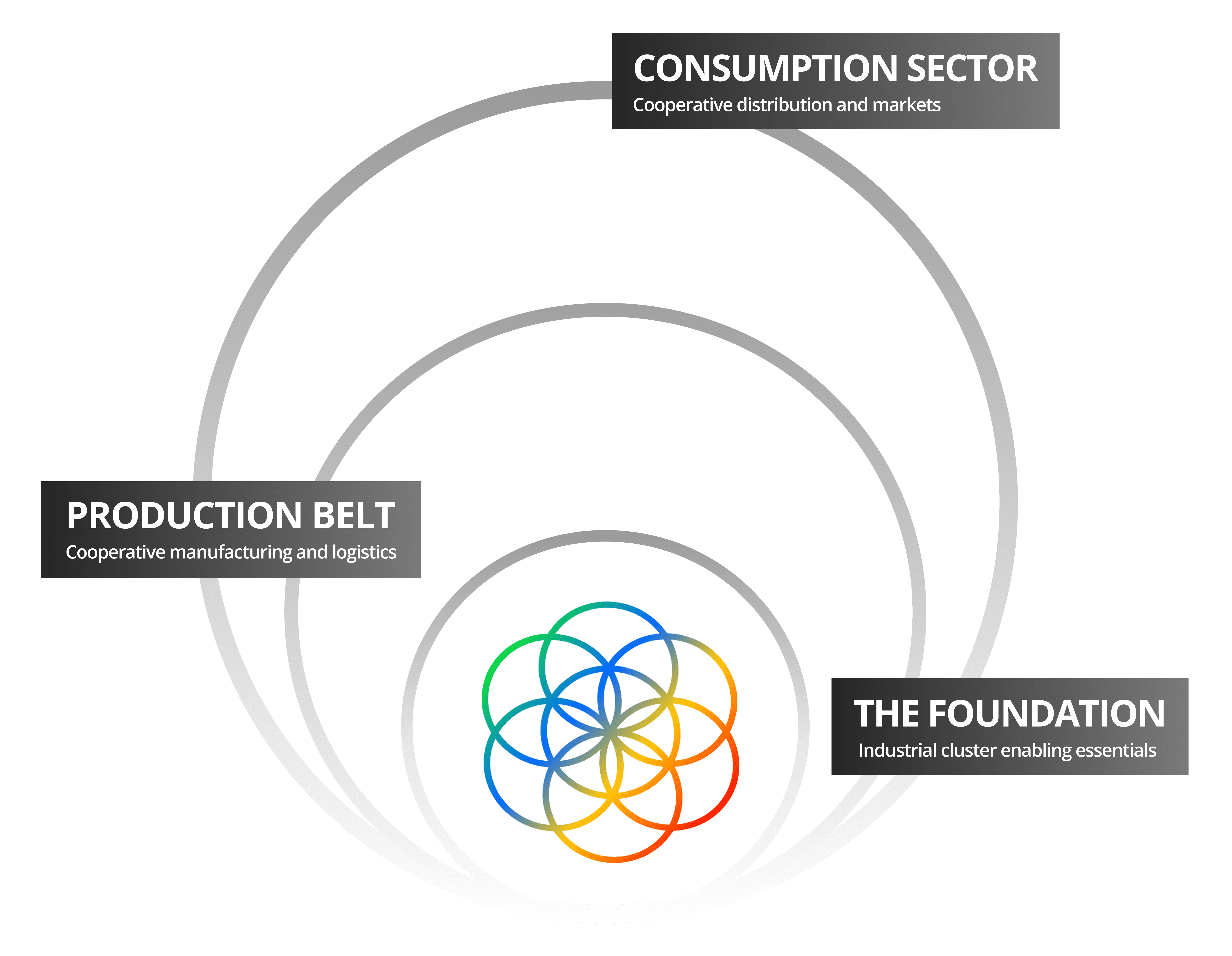
The Foundation
Industrial Cluster
The core of the ecosystem - covering 10,000 hectares - provides the foundation for production, energy, and resource independence. The cluster takes on the most capital-intensive tasks, ensuring that no downstream link is ever compromised by upstream failure.
Autonomous Green Energy
Independent energy supply guarantees the uninterrupted operation of all infrastructure - regardless of the reliability of external grids. Power failure is removed from the risk equation entirely.
Water Supply
Creation of stable irrigation systems for fields, combined with the provision of clean drinking water to local communities. Water security is the non-negotiable foundation of agricultural and human capital stability.
Agrotechnical Base
Centralised and timely provision of high-quality seeds, fertilisers, and digital technological maps to all participants in the process - ensuring that the agrotechnical chain never breaks at the input stage.
Cooperative
Production Belt
A network of local producers - including hundreds of households and women's initiatives - is formed around the industrial core. The belt transitions the economy from a raw material model to one built on high value-added products, integrating local communities into a globally competitive supply chain.
Quality Control
Implementation of strict standards at all stages of production, ensuring that local products meet the global requirements of international markets. Quality is not an aspiration - it is an engineered outcome built into every process.
Medicines and Healthcare
Provision of the community's basic medical needs is a production decision, not merely a humanitarian one. Healthy personnel guarantee that the production process will not be interrupted due to employee illness - removing human capital degradation from the risk chain.
Cooperative
Consumption Sector
A closed internal economy that transforms the local population into active consumers, managed through advanced digital solutions. This tier closes the loop - turning the community from a passive recipient of goods into a self-sustaining economic actor.
Digital Infrastructure
Saturating consumers with modern digital devices - smartphones and tablets - combined with the GROW365™ Platform, which acts as the "brain" of the entire system. GROW365™ links production, processing, and consumption into a single transparent network, providing real-time visibility across every link in the chain.
Digital connectivity does not just improve efficiency. It transforms every participant from a passive actor into an empowered node in an intelligent system - one where data flows as freely as goods and capital.
Tokenomics
Implementation of a token system that serves a dual function: directly rewarding farmers for adherence to proven technologies, and acting as a tool for mutual settlements and the consumption of goods within the community itself.
By creating an internal medium of exchange, the system generates a self-reinforcing economic cycle. Income earned within the ecosystem is spent within the ecosystem - compounding value at every transaction and ensuring that prosperity circulates rather than leaking out.
Summary
Every Link Supports the Others. Zero Probability of Failure.
By integrating water supply, clean energy, proven technologies, processing, and consumption into a single three-level model, WFSI eliminates the very probability of failure. The O-Ring equation no longer terminates in zero - because no single link is left unsupported, unmonitored, or unaccountable.
Foundation
Energy, water, and agrotechnical inputs that guarantee every downstream stage can operate without interruption.
Production
Deep processing, quality control, and healthcare that capture value locally and keep human capital at full productivity.
Consumption
Digital infrastructure and tokenomics that close the economic loop and transform communities into self-sustaining actors.
Each link in the chain supports the others, creating a sustainable environment that permanently lifts a region out of the poverty trap. This is not aid. This is architecture.